
SMS Marketing Pricing 2026: What Should You Be Paying?
 Paul Newham
Thanks to near-universal mobile use, SMS marketing has become one of the most popular marketing channels. With outstanding open and click rates, SMS is a great channel to target large audiences.
But what about returns? Sure, SMS gets lots of opens. But how good is it at turning marketing spend into sales and profit? To judge this, there’s one all-important ingredient to consider. How much text message marketing costs in the first place.
The cost of SMS marketing depends on many factors. The SMS platform you choose. How many messages you need to send. Where you send them. The value you get from text marketing depends on these costs. Understanding them is key to the success of any SMS marketing strategy.
If you’re grappling with SMS marketing costs, you’ve come to the right place. Text marketing pricing can be a little confusing to unpick. But I’ve written extensively about pricing strategy across various marketing channels. I’ve used all my experience sifting through platform pricing plans to put together this guide to SMS marketing pricing.
How Much Does SMS Marketing Cost?
As a baseline, sending 5,000 SMS texts typically costs between $109 and $245. But there are several factors that influence your text marketing costs:
- Location: Per message prices vary a lot by country. And international messaging costs more than domestic.
- Message volume: You always pay more for more messages. But some platforms are better value for mass texting.
- Service type: There are cost differences between subscription and pay-as-you-go services. But it’s important to look into the feature details. Pay-as-you-go services tend to have more paid-for add-ons. But subscriptions usually include everything in one bundle.
- Message length and type: Longer messages cost more to send. As do messages containing images, Unicode characters, or emojis.
- Carrier costs: You may have to pay monthly or one-off telecom operator charges. Some subscription services include this in the price.
- Phone number type: SMS marketing services give you a phone number to send texts from. There are different types of numbers with different costs.
Here’s a quick overview of how much SMS marketing costs for different sending volumes:
| Messages Sent | Price Range | Average Cost |
| 1,000 | $10.90 – $59 | $43.65 |
| 5,000 | $109 – $245 | $189.33 |
| 10,000 | $109 – $490 | $310.17 |
| 50,000 | $899 – $2,450 | $1,462.60 |
| 100,000 | $1920 – $4900 | $3,608.33 |
See the table below for how much sending 1,000 SMS in the US costs:
| Free Credits | Monthly Price for 1,000 SMS (US) | |
| TextMagic | 10 (free trial) | $59 |
| SlickText | 50 | $49 |
| Brevo | 0 | $10.90 (Full Brevo pricing guide) |
| SimpleTexting | 50 (free trial) | $49 |
| EZ Texting | 120 (free trial) | $45 |
| Textedly | 50 | $49 |
SMS Marketing Platform Fees
There are two main pricing models for SMS marketing platforms. Monthly subscriptions or pay-as-you-go (PAYG). PAYG services often (but not always) offer lower per-message prices than paid plans at subscription services. But subscription services include extra features in the price. You have to pay for add-ons with PAYG.
Subscription services also give you a fixed amount of credits every month. With PAYG, you only get more credits when you pay for them. You can use the ones you’ve bought for as long as you like. Many providers let you carry over credits you don’t use each month. But you can quickly build up a lot of unused credits as they renew each month.
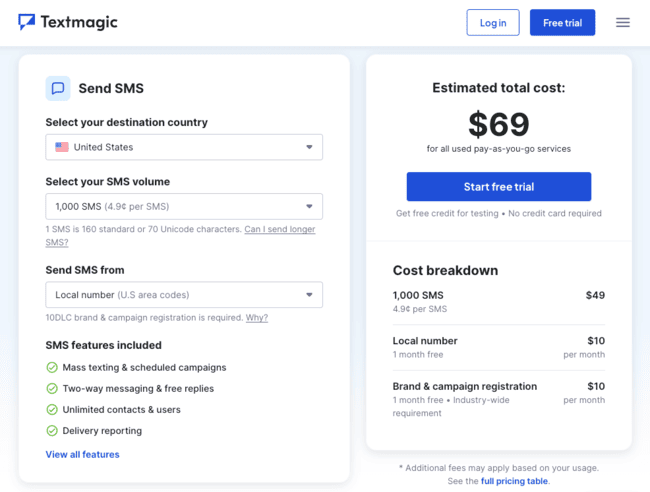
PAYG is more flexible. It tends to be more cost-effective for lower-volume senders. And works well if your SMS needs vary. TextMagic only offers pay-as-you-go, and you can easily calculate your costs on their pricing page. Read our full TextMagic review to find out more about its features, pros, and cons.
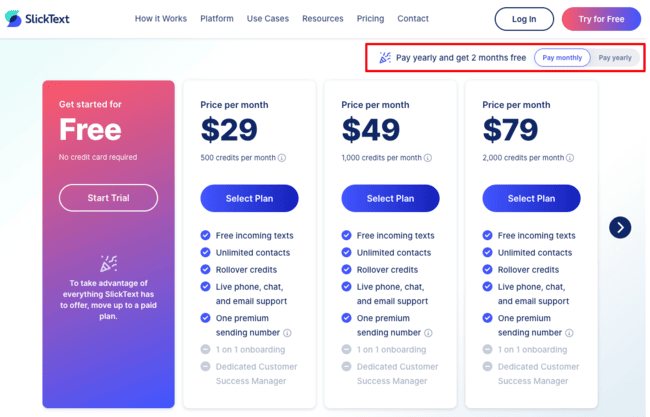
Subscriptions give you consistency if you know how many texts you need to send each month. Especially at higher volumes. A lot of subscription services also include additional marketing features. Like message templates, segmentation and automation tools, and analytics. And you can get discounts for paying for 12 months at a time. SlickText has subscription plans and gives 2 free months if you pay yearly:
Some platforms offer both subscriptions and PAYG. A hybrid pricing model is great for starting small. Then you have the option to scale to higher volume sending as your business grows.
SMS Marketing Messaging Fees
Nearly all SMS marketing services quote prices for X number of SMS credits. But the number of credits you buy isn’t necessarily the number of SMS messages you will send. And the cost per credit quoted isn’t necessarily what you will pay per message.
You will eat up more credits by sending longer SMS marketing campaigns. Or by sending anything other than plain text messages. A single SMS segment allows 160 characters. Longer messages cost extra credits. Same if you use Unicode characters or emojis. MMS messages typically cost 3 credits.
Messaging fees also vary by destination country. And it costs more to send SMS messages internationally than in your own country.
You should also check to see if incoming messages are included. And how many contacts you get. The best services these days include two-way messaging in the price. And unlimited contacts. But if this isn’t the case, that can increase your costs a lot.
Phone Number Fees
SMS marketing services provide phone numbers for you to send text messages from. There are three types of numbers.
- Toll-free numbers: Numbers reserved for business use, recognisable by specific dialling codes.
- Long code (or local) numbers: Standard phone numbers.
- Short code numbers: Abbreviated numbers, usually 5 digits.
Toll-free numbers originally gave customers a way of calling businesses free of charge. The business receiving the call paid the fees. Text marketing services use them to offer free numbers. So usually there’s no additional charge on top of the message fees. However, there’s the danger of unknown business numbers being ignored as spam.
Long code numbers are more easily recognised as ‘genuine’ phone numbers. So some businesses feel they give better open rates. Short code numbers are preferred by businesses that want to encourage inbound texting. Short codes are easy to include in SMS marketing campaigns and are easier for people to use. Long and short code numbers nearly always have extra charges. Short codes cost more.
For an extra additional charge, some services let you replace a number with an alphanumeric sender ID. This means you can display your business name to recipients instead of a number.
Add-ons and Extras
SMS marketing services often offer more than just sending text messages. These may affect how much a service costs, depending on the service’s pricing structure. A lot of subscription services, for example, include extra features in the price. But this tends to bump the base cost. Others, especially PAYG services, offer more features as add-ons.
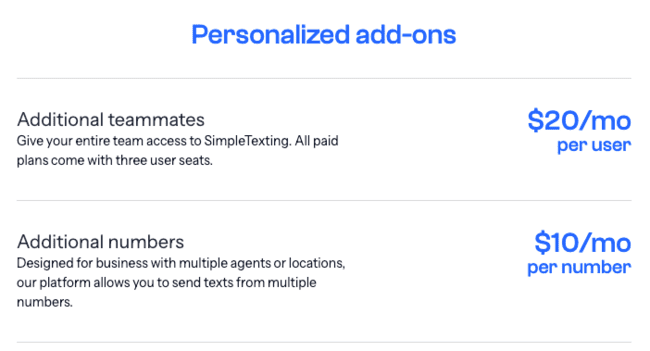
Some common add-ons and other fees in text message marketing tools include:
- Subscription keywords that recipients can use to sign up for or leave a list.
- Extra phone numbers.
- Auto-responder and drip campaigns for automating SMS sending.
- Campaign analytics.
- Pay-by-text and other SMS payment options.
- Other marketing tools, such as CRM and email marketing.
- Adding more users.
- Third-party integrations and API access.
How to Calculate SMS Marketing ROI
You need to know what SMS marketing costs to calculate Return on Investment (ROI). ROI tells you if spending on a service or product for your business is worth it. If you make more from the investment than you spend, all is good. If not… you’d better have a rethink!
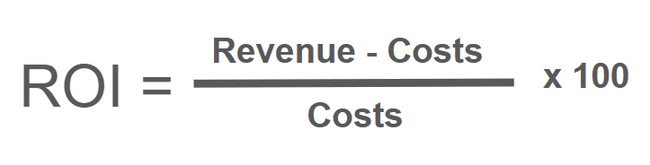
ROI is calculated as the percentage gain you get from a business activity. You do that in three steps:
- Work out how much you earn from any given activity (revenue) and what it costs.
- Subtract costs from revenue to give you your profit.
- Divide profit by costs and multiply by 100 to give you an ROI percentage.
As a formula, the ROI calculation looks like this:
Working out revenue from SMS campaigns is pretty straightforward. SMS marketing is more sales-focused and transactional than, say, email marketing. You’re not sending out many text messages to raise awareness or distribute a newsletter. Direct payment links, unique landing pages, and promo codes make it easy to attribute sales back to the campaign.
From there, working out ROI is easy. Let’s work through an example. Say you’ve sent out a campaign to 1,000 contacts. The average cost for 1,000 messages is $43.65. But on top of that, you pay $10 a month for a long code local number. And $5 a month in carrier fees. So total costs are $58.65.
Say you make $150 in sales from the campaign. The ROI would be:
$150 – $58.65 = $91.35 / $58.65 = 1.56 x 100 = 156%
From the same set of data, you can also calculate Revenue per Message (RPM). In this case, it would be $150 / 1,000 = $0.15. RPM is a useful metric for comparing performance across campaigns.
Other key metrics to measure include click-through and conversion rates. Click-through rate (or CTR) tells you how many page visits you’re getting. This is a good indication of how engaging your campaigns are. Low CTR tells you there’s low interest. And you’re unlikely to get a strong ROI. Similarly, conversion rate tells you how many clicks lead to sales. This is good to compare to revenue. A high revenue but low conversion rate suggests you’ve had a small number of high-value sales. That could be an outlier that’s hard to repeat.
It’s also a good idea to keep track of list growth and opt-out rates. It’s hard to increase revenues from a static audience. So list/lead growth is an important part of any marketing activity. But you don’t want your lists getting smaller. If you have a high opt-out rate, you have an issue with relevance and engagement.
How Profitable is SMS Marketing?
SMS marketing is popular because it delivers results. Text messages have incredibly high open rates of up to 98%. 82% of people say they open every SMS they receive, compared to 81% who say they ignore all calls from businesses. Good open rates lead to high click-through rates, too. The average CTR of SMS marketing is 19%, way ahead of social media (1%).
Good open rates convert into sales, too. 72% of consumers have made a purchase after receiving a text message. And 65% say that SMS marketing speeds up their intention to buy.

As a result, 73% of SMS marketers say that text campaigns help them boost revenue. Precise ROI depends on factors like campaign size, industry, and input costs. Businesses can expect a 25x return on SMS marketing.
Which SMS Marketing Pricing Should You Choose?
So that’s my guide to SMS marketing pricing. What are the main takeaways?
Cost plays a big role in whether you get good returns from your SMS marketing efforts. Good ROI relies on getting the right balance between cost per message and revenue per message. That means choosing a pricing model that suits how you use SMS marketing. And particularly, how many messages you plan to send.
For lower-volume or seasonal sending, PAYG pricing works out better value. It tends to be cheaper outright. Brevo, for example, starts at just $10.90 for 1,000 texts. You can take as long as you want to use the credits before you pay again. And you can pick and choose the add-ons you need. TextMagic costs $59 for 1000 SMS in the US with a toll-free number.
For larger volumes, subscription services offer bundles of 50,000 or 100,000 credits a month. These come with heavy bulk discounts. They also include marketing tools that help with bigger and more frequent campaigns. SlickText has a plan with 50K credits for $939. That’s $321 cheaper than sending 50K SMS with TextMagic.
Compare the costs of email and SMS with our email marketing pricing guide.