
No CDP, No Regrets? Why data maturity always comes first
 Niels van Meerte Janse
TLDR: To increase your data maturity, you don’t always need more tools. Think twice before investing in a/another CDP. It’s likely there are smarter ways to become truly data-driven. We look at investing in your data foundation, people, and a dual-core strategy alternative.
CDPs promised us a 360° customer view, but the reality of CDP implementation turns out to be rather less sunny. In my experience, it can be a big letdown. Budgets and implementation time can run over, data becomes unreliable over time, and compliance breaks down.
So in practice, it isn’t always a sensible next step for mid-market or smaller organisations, especially if they don’t have a CDP yet.
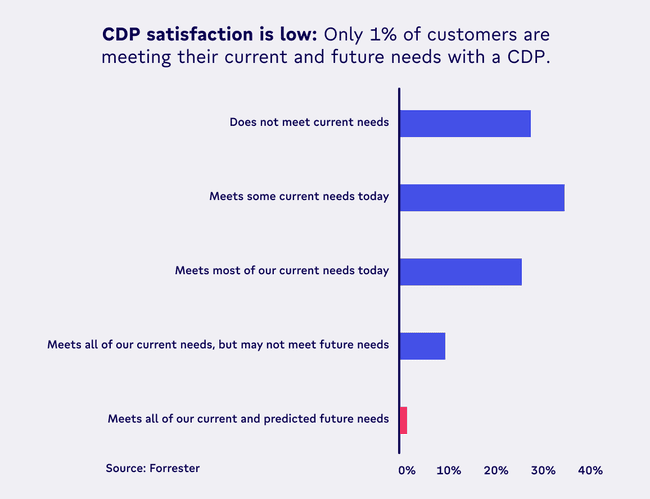
This is also what we are seeing in the data. This gap between promise and practice is supported by Forrester and Zeta’s study from back in 2022, which found that just over half of companies said their CDP met most of their current needs. Yet only 1% believed it would fully meet their future requirements.
While many organisations were satisfied with their CDP at the time, few are convinced it will remain suitable as their needs continue to change. We now see this playing out across organisations:
- The first investments didn’t stand the test of time.
- The pace of change was faster than expected.
- The future is already here, leaving many CDPs unable to keep up.
Where many, myself included, once advised clients to invest in more tools and chase the next big thing (often a CDP). I’ve come to realise: it’s not about technology. It’s about the data and the people who know how to work with it.
The power of data hygiene: two strategies compared
I used to work agency-side with two retail clients operating under nearly identical conditions, both generating around 80% of sales offline and 20% online.
| Tech-Led Approach | Data-Led Approach |
| One client, in which we heavily invested in advanced technology, a CDP, and multiple AI tools. | The other client focused on improving data hygiene and segmentation within their existing CRM. |
| The outcome was a 25% increase in online sales, but almost no impact offline, only around 5%. | The outcome was a performance increase of up to 75% in online sales, and an impact of 45% in their offline sales. |
| There was little trust in the data. Teams often asked: “Which customer does this data belong to?” As a result, the tools were used less, and many insights were ignored. | Thanks to more reliable data and contrary to expectations, they started using the tools and the insights much more, simply because they could trust them. |
To become truly data-driven, you can’t keep throwing tools at the problem. Start by making your existing stack smarter by activating better data in the right places and with the right people. That doesn’t necessarily require a CDP. At least, not anymore.
The scenario above wasn’t an exception. We saw similar patterns across many brands in different industries. If your business is almost entirely online, a CDP-led approach can still take you far. But especially when offline sales play a bigger role, or when multiple brands and domains are involved, a CDP alone is not the answer.
The evolution of the martech stack
Scott Brinker’s and Frans Riemersma’s 2025 MartechMap tracks over 15,000 tools, a 9% increase year over year. Their research also sheds light on how B2C stacks are evolving, and the shift in core usage is striking:
- CDP centrality falls from 27.3% to 17.4%
- Cloud Data Warehouses have risen to 23.9%, becoming the leading data hub
- Marketing automation platforms have climbed to 26.1%, taking the lead in activation within the martech stack
Many teams are moving away from using the CDP as the centerpiece of their stack. Even though some vendors and agencies continue to advocate for it. Are we witnessing a trend that users are recognizing well before some market experts?
Originally rooted in the marketing department, CDPs are now shifting into the domain of IT. As data becomes more strategic, its relevance has expanded beyond marketing to the boardroom, drawing in CIOs, data leads, and CFOs into key decision-making processes. What began as a marketing need has evolved into a driver of broader business strategy.
This shift brings new pressure to deliver measurable results, demanding expertise that often lies outside the traditional marketing team. Data-driven roles are stepping forward, while marketers focus on activation with tools like personalization engines and marketing automation platforms.
Despite being positioned as a strategic cornerstone in the martech stack, Customer Data Platforms (CDPs) continue to suffer from low adoption among business users. As noted in Gartner’s 2025 Magic Quadrant for CDPs:
“Despite the strategic importance of CDPs, their use by business users remains low, with only 22% of marketers reporting high use. Instead, marketers often rely on other solutions… CDPs are serving as enabling technologies rather than primary tools for marketing operations.”
Further evidence comes from Gartner’s 2025 Critical Capabilities for Customer Data Platforms report. The report highlights a broader decline in martech utilisation, dropping from 58% in 2020 to just 33% in 2023. CDPs are not exempt from this trend. In 2024, marketers used only 53% of their CDPs’ available capabilities on average.
Beyond underuse of features, as much as 68% of incoming data remains unused in practice. This is often due to CDPs replicating only a limited set of data fields rather than unlocking the full dataset. As a result, valuable information is left untapped. Not because it doesn’t exist, but because the system fails to make it accessible or actionable.
CDP adoption continues to face significant challenges. Meanwhile, AI, composable architectures and zero-copy data sharing are emerging as important components of the modern martech landscape.
Given these shifts, it makes perfect sense to decouple CDP capabilities: assigning data management to IT and data teams, while embedding activation features into the marketing tools professionals already use every day.
An alternative: the dual-core martech strategy approach
The industry continues to debate: do we need composable or traditional stacks? In reality, every organisation needs both. Each team operates at a different pace and has a different appetite for risk.
To support both, and to combine data management with activation capabilities, mid-market and smaller organisations would do well to learn from the mistakes that enterprise players have already made and are now working to resolve.
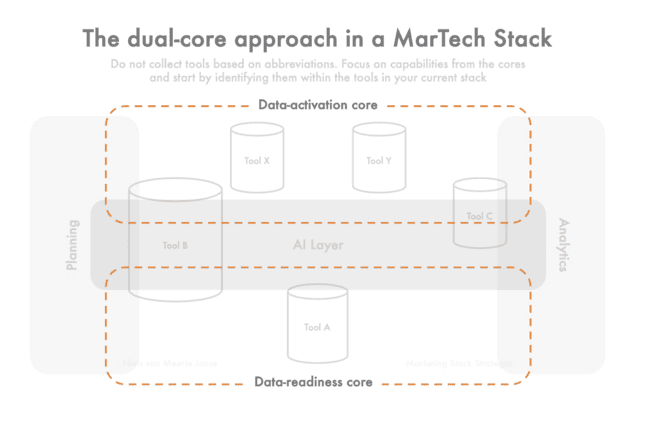
Rather than relying on an all-in-one CDP to drive data maturity, consider enabling two dedicated core capabilities within your martech architecture, placing each where it fits best:
1. A data-readiness core
This is typically located in your cloud data warehouse. Though it can also be set up elsewhere (or temporarily elsewhere). It acts as a dedicated data layer focused on marketing- and customer-specific data. This layer is responsible for quality checks, metadata enrichment, and privacy safeguards. Much of this processing can be done in batch to reduce costs and minimise risk.
Importantly, this layer is distinct from your operational data or customer view. Think, for example, of data from unknown visitors or promotional campaigns, the kind of data you don’t want polluting your CRM or operational DWH. These datasets are often managed by different teams with different expertise, and marketing data is typically less structured and less precise than operational data.
For data engineers, data often needs to be 100% accurate. Marketing data, however, rarely meets that standard. And that’s okay. It operates under a different dynamic, where speed, experimentation, and directional insight often matter more than precision.
2. A data-activation core
In most cases, this is managed by your marketing automation platform or similar tools. It forms the real-time layer to activate the processed data: personalisation engines, campaign orchestration, real-time triggers, and customer journeys. It’s where data becomes action.
Real-time, where needed, but deliberately not everywhere. Real-time capabilities come with costs: in infrastructure, complexity, and risk. Not every use case requires millisecond precision. In many cases, near-time or batch activation is more than sufficient and far more sustainable.
This layer relies heavily on the quality and structure of the data flowing in from your readiness core. Without that foundation, even the most advanced activation tools will struggle to deliver relevant and timely experiences.
We’re now seeing a new generation of tools emerge. Tools that no longer depend on their own internal data foundations. Instead, they connect directly via zero-copy integrations (no data deduplication). This makes these systems not only more flexible but also significantly more efficient. It’s no coincidence that Bloomreach is partnering strategically with Google BigQuery and Salesforce with Snowflake, encouraging customers to move away from proprietary data storage and towards more open, scalable architectures.
While these established marketing platforms are now adjusting their vision, they still face the challenge of adapting their legacy systems to this new approach. And it remains to be seen how far they can go. Meanwhile, other software, often from outside the traditional martech space, have embraced this vision from the start.
Take SAS Customer Intelligence 360, for example. It has embraced zero-copy architecture from the start, a natural result of its deep roots in data and analytics and its design to work with data stored in external environments. This foundation enables the platform to operate several steps ahead in the ongoing evolution of marketing technology.
Software like this is becoming increasingly attractive as marketing moves closer to data and IT. They offer a strong foundation that empowers marketing teams to activate more effectively, while also meeting the technical standards that data and IT teams require and trust.
SAS has been developing intelligent systems that solve business challenges with analytics and AI for nearly 50 years. With extensive experience in handling sensitive data across industries, it’s no surprise that the company is well-positioned for this shift. As marketing becomes more data- and AI-driven, organisations like SAS, grounded in analytics rather than marketing or advertising, may prove to be the more logical and future-ready choice. Especially compared to platforms that originated in marketing and often collected data in less structured or compliant ways.
These 2 cores don’t need to be tied to a specific tool. They represent a layer of functionality that requires certain capabilities, which can be delivered through a single platform, a set of smaller tools working together (via zero-copy integration, for example), or even partially embedded in existing systems or temporary processes.
As more organisations shift to using first-party data, the kind collected directly and with consent, the dual-core approach makes even more sense. It allows teams to keep data handling tight while staying flexible on activation. Many companies now focus on collecting first-party data through their CRM, loyalty programs, and websites.
Instead of letting a CDP collect everything, they send these first-party data streams to a central data warehouse. This gives them more control, makes it easier to scale, and keeps data management and activation separated.
What matters is not the tooling itself, but whether you have the right competencies. These are data competencies. And while marketing teams often view this as an IT responsibility, slow, heavy, and complex, it’s becoming increasingly clear that bypassing the proper route may lead to even bigger challenges down the line.
Pull in only the CDP features you truly need and let each system play to its strengths. A CDP is an activation tool, not a standalone data software. The overlap between CDPs and tools already present in your martech stack is growing. So, invest in making your current stack smarter.
For many organisations, that starts with addressing customer data management first, not by buying more tools, but by building the right foundations. And don’t forget: there’s a difference between data for marketing and data for operational processes. Treating them the same leads to confusion, inefficiency, and missed opportunities.
AI as the next piece of the stack (and a confirmation of the dual-core approach)
When reviewing your martech stack today, one development is impossible to ignore: AI. It’s essential to give AI a well-considered place in your architecture. Many tools in the data-activation core have invested heavily in AI, but is that the right place?
Many activation tools end up archiving older data just to keep performance smooth and SaaS costs manageable, especially with prices climbing again. In 2024, we saw a 9.3% year-over-year increase in average SaaS spend, the first rise in three years. Experts expect this trend to continue. Gartner forecasts global SaaS spending to reach $299 billion in 2025, up from $250.8 billion in 2024, a 19.2% increase. Therefore, it is not ideal to store extensive historical data, given the rising costs and associated risks.
AI works best when it’s backed by two solid foundations. First, a well-structured data layer with historical context, typically processed in batches to keep costs down. Second, a flexible activation setup that can react quickly when it matters. One provides depth, the other brings speed. You’ll need both.
A few CDPs promise the best of both worlds: deep AI analysis and fast real-time triggers. But in practice, that’s a tough act to pull off, especially on a single platform. Modern data-CDPs are moving in that direction, but they do so by adopting a dual-core structure. For example, Tealium offers two storage formats, structured and semi-structured, allowing you to work with your data in whichever way suits your needs.
Feed your models with clean, well-governed data from the readiness layer and let the activation layer handle real-time triggers, recommendations, and personalisation. As highlighted in this Forbes Expert Panel article, ethical and effective AI integration depends on strong data foundations. Neglect either layer or apply them poorly, and you won’t get a refined, high-impact outcome. Instead, you’ll be left with an undercooked data stew: messy, inconsistent, and hard to serve.
There’s no need to get caught up in the differences between CDPs, DMPs, or marketing automation platforms. Instead, focus on closing the capability gaps in your current tools and build a dual-core, modular stack that avoids incomplete results.
A useful reference for this is the model below, which outlines the building blocks of a martech stack. While broad, it clearly shows which components you might need, regardless of which tools they sit in. This model illustrates it very well Download the full-size model here
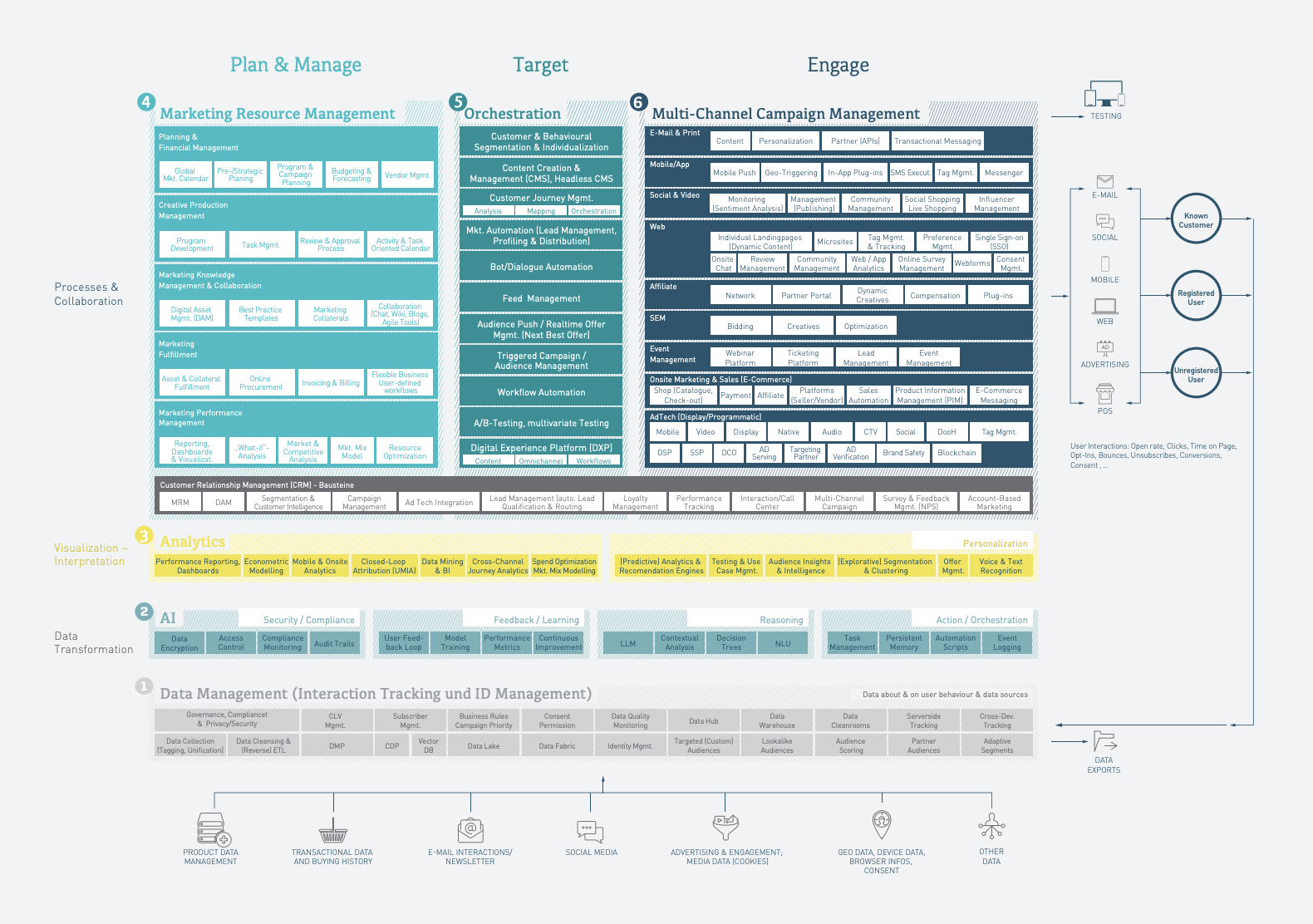
Source: Yearly Marketing Tech Lab research
Enterprises have already embraced this split between data-readiness and data-activation layers, powered by zero-copy integration and true zero- and first-party data for real-time orchestration and AI-driven insights.
Mid-market organisations, however, often still carry hidden data challenges. Relying on a standalone CDP risks masking the problem rather than solving it.
Future-proof businesses, large or small, build their own data foundations beyond cookie-based tracking and based on zero and first-party data. This helps them grow with confidence. And, as fast-moving challengers, stay competitive. Even with the bigger players in their market.
You don’t need to rebuild everything from scratch. By addressing data at the right points, rather than within each individual marketing tool, you can make your existing stack significantly smarter, especially with the right people involved. Modern stacks are no longer built around a single dominant platform. They’ve become modular and adaptable, shaped to fit how companies operate today, not how software was packaged and sold in the past.
Key Takeaways
- CDPs rarely provide a complete 360° customer view and often create more confusion than clarity.
- Separate data readiness (in a cloud data warehouse with governance, consent management, and quality controls) from data activation (in your marketing automation or personalisation tools).
- Use a modular, warehouse-first architecture to avoid vendor lock-in, hidden costs, and unnecessary complexity.
- Marketing data differs from operational data. It can be stored as a separate layer within your data warehouse, but in many cases, it’s also valuable to maintain a dedicated marketing database built on warehouse technology.
- AI only works well when it uses clean, well-managed historical data and is supported by a simple, real-time activation layer.
- Put people and processes before new tools. Focus on having the right data in the right places, with the right expertise to generate real insights and results.
Is your CDP really giving you a full 360° view? Or, if you’re honest, is it more like a bubbling data stew that leaves you unsure of what’s actually in it?