
Research: Are CRM and Automation still the center of the Martech stack?
 Frans Riemersma
The days of implementing a platform, sitting back, and waiting for a miracle to happen are long gone. That has never been true, but recent research shows that brands nowadays carefully position their CRM and marketing automation platforms within their stack.
Organizations aren’t just swapping tools. They’re building a more mature martech stack, assigning roles to platforms, and rethinking how their stacks are designed.
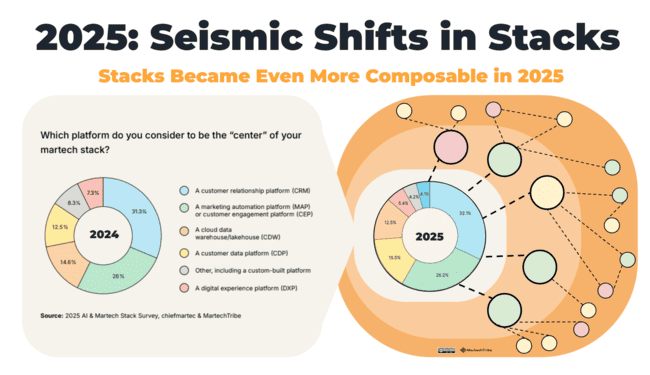
The central software point that integrates with more than half of the stack is shifting. Our updated 2026 data reveals the center of the stack is moving, especially for CRM and marketing automation platforms (MAPs).
You can think of your marketing technology as a solar system, with a “sun” at the center. Data shows that other software is taking over this central software role.
The martech landscape has grown more than 100x since 2011
The martech landscape grew 9% since last year to what is now a whopping 15,384 software tools. And you may ask what that means for companies and their stacks. While new AI natives grow, the previous generation is consolidating more. But more to the point of this article, we see the types of software that are in the center of the stack shift.
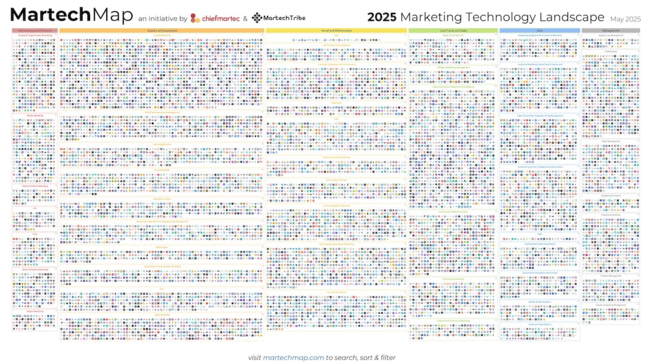
The 2025 Marketing Technology Landscape. Read the full report here
In some industries, customer relationship management tools and marketing automation platforms have become the central platforms. In others, they orbit around a Customer Data Platform (CDP) or Cloud Data Warehouse (CDW).
For example:
- Professional Services and Technology Providers mention CRM twice as often as their central platform as other systems.
- In Consumer Products or Banking & Financial Services, Data warehouses and Customer Data Platforms are mentioned twice as often compared to other systems like CRM.
The most striking outcome of our research is how different the trajectory is for B2B vs. B2C companies. CRMs remain stable in B2B while MAPs retreat. In B2C, CDPs are losing ground as the center shifts toward dual-core setups built around Cloud Data Warehouses and MAPs.
B2B Martech Stacks: From Consolidation to Customization
In B2B marketing technology stacks, the CRM remains firmly at the center. Slightly increasing from 41.6% to 42% year-over-year, its dominance as the gravitational core of B2B stacks is unmatched.
This stability signals that CRM continues to serve as the anchor for customer data and engagement across channels. While CRM holds its ground, other parts of the B2B stack are in motion.
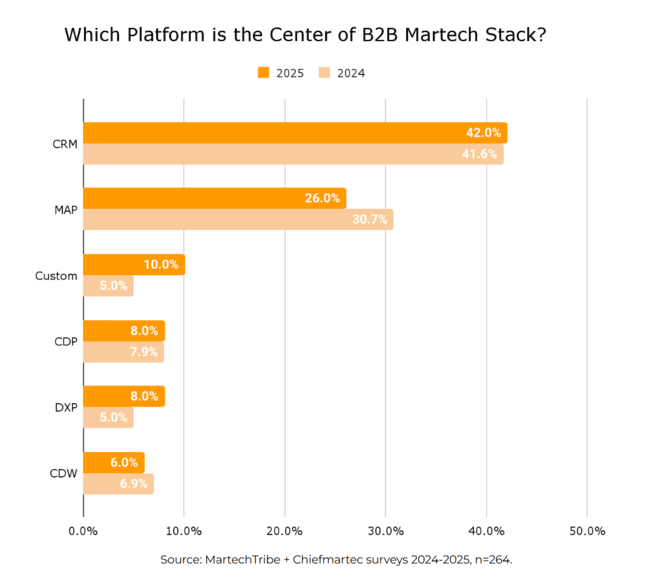
MAPs, once co-starring with CRMs, are losing altitude. Their centrality dropped from 30.7% to 26%, suggesting that B2B organizations are not putting automation at the heart of the stack. The shift indicates a move away from (rigid) process-driven stacks toward more agile, customizable infrastructures.
This shift is most apparent in the rise of digital experience platforms (DXPs) and custom-built platforms. DXPs rose from 5% to 8%, while custom-built platforms doubled, from 5% to 10%. This dramatic increase points to a growing appetite for composable architectures tailored to unique customer journeys, use cases, and business models.
Meanwhile, customer data platforms (CDPs) and cloud data warehouses (CDWs) remain small in B2B environments, each accounting for only low single-digit adoption as core systems. Rather than consolidating on generic data layers, B2B companies are opting to assemble purpose-built ecosystems.
It looks like B2B martech stacks are entering a phase of architectural experimentation, anchored by CRMs, but expanding outward with modular and custom components. Its move from platform consolidation to stack customization reflects a broader shift toward flexibility and control.
B2C Martech Stacks: The Great CDP Redistribution
Customer data platforms (CDPs) aren’t disappearing, they’re evolving. Once the central hub of many B2C and hybrid martech stacks, CDPs have now seen their role redistributed.
In just one year, CDPs dropped from 27.3% to 17.4% as the reported “center” of the stack. But this isn’t about irrelevance, it’s about reconfiguration.
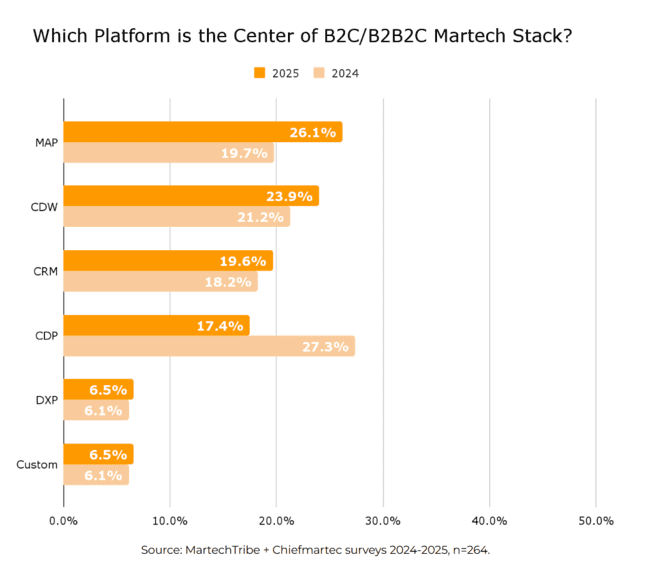
Core CDP functions are being absorbed in two directions.
- Upstream, cloud data warehouses (CDWs) have grown to 23.9% adoption as the stack’s center, taking over the foundational role of storing and activating unified customer data.
- Downstream, marketing automation platforms (MAPs) have surged to 26.1%, becoming the go-to platforms for executing that data through messaging and campaigns.
The result is a dual-core stack architecture: one core optimized for data management and another for activation. CDP-like capabilities remain essential, but they’re no longer centralized in a single platform.
Meanwhile, CRMs in this segment saw a modest increase from 18.2% to 19.6%, still playing a supporting role compared to MAPs and CDWs.
This unbundling reflects a broader shift toward composable stacks: decoupled, modular architectures where no single tool tries to do it all. For B2C and hybrid organizations, it’s not about eliminating the CDP, it’s about right-sizing it and redistributing its value to where it performs best.
AI: The Stack Catalyst
Artificial intelligence is accelerating this transformation in two major ways. Inside-Out, by adding new GenAI native tools as well as embedding AI capabilities natively into SaaS tools.
And Outside-In, by introducing external orchestration layers, LLMs, AI agents, and co-pilots, and MCPs that connect disparate tools and marketing automation workflows. These layers require a flexible foundation.
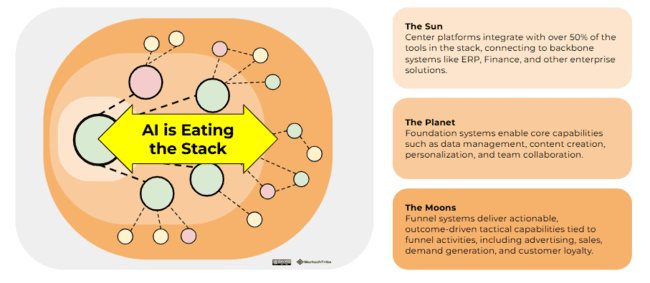
The role of AI in powering the LEGO-like Composability of your Stack
AI, together with changing buyer expectations, is accelerating the change in how martech stacks are put together.
AI is powering the underlying composability of martech. Composability means assembling tools and features like LEGO blocks into tailored customer experiences.
This idea isn’t new. Software has always been built modular by design. Behind the scenes, software is made out of components, libraries, plug-ins, objects, and classes.
The change is that this modularity is not just inside the applications anymore. Those components are now accessible across the entire company marketing stack.
Composability has moved up a level, from software architecture to stack architecture.
Stack Smart, Not Hard
The recent shifts in martech center platforms, CRMs holding steady in B2B, CDPs giving way to MAPs and CDWs in B2C, signal more than just changing tools. They reveal a fundamental redefinition of what a martech stack is.
Stacks are no longer rigid systems centered around one core platform. They are becoming modular, composable, and adaptable, shaped around how companies need to operate today, not how software was sold yesterday.
Custom-built cores in B2B and dual-core models in B2C are both symptoms of this transformation. Instead of a single point of gravity, stacks now orbit multiple specialized systems that are easier to reconfigure and swap out.