
9 Free DMARC Monitoring Tools in 2026 (Tested & Reviewed)
 Paul Newham
You see lots of emails land in spam or get rejected, and can’t figure out why? Do you suspect that your sender reputation has taken a dive as a result?
If any of that sounds relevant to you, it sounds like you need to beef up your email authentication and deliverability. In this article, we’re talking about one of the best tools for email authentication. DMARC monitoring tools. And more than that, we’re going to share, compare, and assess the best DMARC monitoring tools around.
As a long-time email marketer, I know how important email authentication is. These are DMARC monitoring tools I’d be happy to use myself. But they all offer something a little different. With their own strengths and weaknesses. I’ll cover all of that, all their main features. And of course, what they cost.
9 Best DMARC Monitoring Services Overview
Here’s a summary of pricing and overall rating for our top 9 DMARC monitoring services. Prices provided are for access to DMARC services.
| Free Plan / Trial | Starting Price | Score | |
| Bouncer | Yes, 14 days | $25/month |  |
| EasyDMARC | Yes | $35.99/month |  |
| ZeroBounce | Yes | $49/month |  |
| Postmark | Yes | $14/month |  |
| Valimail | Yes | $19/month | |
| PowerDMARC | Yes | $8/month | |
| DMARC Advisor | Yes | $19/month |  |
| Dmarcian | Yes | $19.99/month |  |
| Cloudflare | Yes | $25/month | |
What is a DMARC Monitoring Service?
DMARC is one of the main protocols used to authenticate if emails are genuine. Senders use it to combat email spoofing. This is when spammers and phishers try to use your email domain fraudulently to send fake emails. Falling victim to spoofing can be devastating for your sender reputation. So authentication is important for maintaining good email deliverability.
DMARC gives mailboxes instructions based on analysis of two other authentication protocols, SPF and DKIM. Every email address has a domain, the part after the @ sign. It’s easy to start using an email domain you don’t own fraudulently. But SPF and DKIM records authenticate genuine addresses that belong to a domain.
If SPF and DKIM records don’t check out, that suggests an email address is fake. DMARC then steps in to tell the mailbox what to do. Either block the email or quarantine it for further inspection. These instructions are called a DMARC policy.
DMARC policies can also include instructions to report on blocked or quarantined emails. This is important because failed authentication doesn’t always mean a fake address. It could be that you haven’t kept up with your DKIM and SPF records. A DMARC report lets you check this.
The only problem is, DMARC reports are XML data feeds. They’re called DMARC aggregate reports. And they’re meant for machines. So this is where a DMARC monitoring service comes in. It turns the raw data of a DMARC report into something intelligible and usable. This is how you get details about blocked and quarantined emails. And armed with that insight, you can do something about it.
9 Best DMARC Monitoring Services Reviewed in 2026
Bouncer
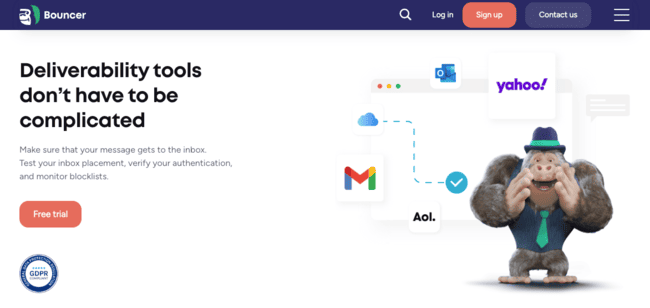
Bouncer is an all-round email deliverability service. It’s best known for email verification. You can use it to check email addresses are genuine and working before you hit send. This reduces bounces and improves your sender reputation. It uses multiple tools to verify emails. Some, like DNS and MX record checks, are closely related to DMARC monitoring.
Bouncer also has an inbox placement testing tool called the Deliverability Kit. Inbox placement testing measures how many emails are landing in inboxes. But tests also incorporate blocklist monitoring and authentication checks. So for every non-delivered email in a test, you can look up the causes.
This integrated approach is Bouncer’s strength as a deliverability service. Inbox placement testing, blocklist checks and DMARC monitoring sometimes come separately. The fact that they all feed into one deliverability test is very user-friendly. Plus, Bouncer’s email validation system supports better DMARC results. Bouncer’s verification tools include automatic list cleaning, removing fake and failed addresses. Cleaned lists mean fewer authentication failures.
Bouncer Pros
- All-in-one deliverability package
- Integrated inbox placement testing, blocklist and DMARC monitoring
- Free email validation
- Automated list cleaning
Bouncer Cons
- Sometimes it would be useful to run standalone DMARC checks.
Bouncer’s Deliverability Kit starts at $25 a month for 250 test emails. This covers 10 IP addresses and domains for monitoring. Email verification starts at $8 for 1000 emails. Or you can get $2 off by going for a monthly plan. You get 100 verification credits for free.
Get started with Bouncer for free or read our full review
EasyDMARC
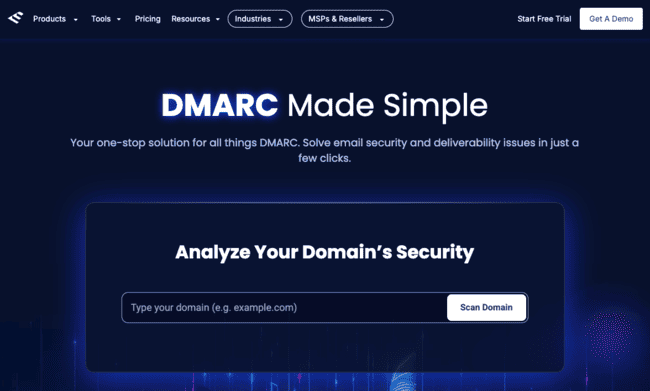
EasyDMARC is a specialist email authentication service aimed at high-volume senders. It focuses on DMARC monitoring and reporting. It tracks DMARC records over time, displaying results in an easy-to-read visual dashboard. This helps senders identify patterns in authentication issues. And it also includes detailed reports on every failure.
Many of EasyDMARC’s authentication tools are available for free for quick checks. They include DMARC, SPF and DKIM record checkers and generators. A DNS record checker, domain scanner and reputation monitor. There is also a useful free plan. At the opposite end of the scale, EasyDMARC also offers managed authentication services.
EasyDMARC has a sister product called EasySender. This includes an email verification tool and inbox placement testing. Both are priced separately. And inbox placement testing in particular is pricey.
EasyDMARC Pros
- DMARC monitoring for high-volume senders
- User-friendly dashboard and detailed failure reports
- Free plan and a long list of free authentication tools
- Cloudflare integration
EasyDMARC Cons
- Expensive if you don’t have high sending requirements
EasyDMARC pricing starts at $35.99 per month for 100,000 emails and two domains. There is a free plan that monitors 1,000 emails a month from a single domain.
ZeroBounce
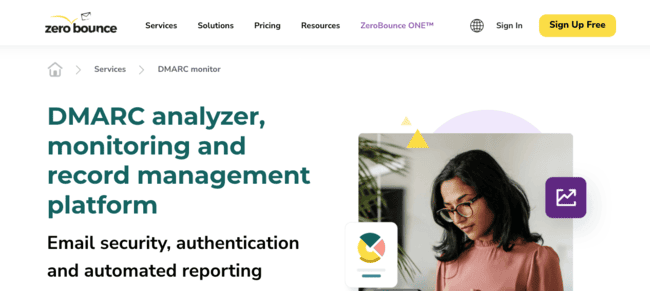
ZeroBounce is an email deliverability platform. It starts with email validation. But it also has inbox placement and server testing. Blacklist monitoring. IP warm-up. And DMARC monitoring. There are also email finder tools thrown in, too.
For DMARC monitoring, ZeroBounce lets you register multiple domains. Configuration is simple via a user-friendly wizard. Once set up, ZeroBounce doesn’t impose any email limits. It monitors DMARC reports for every email you send from each connected domain. You get domain-by-domain performance reports. And you can set up email alerts to get notified every time an email fails authentication.
ZeroBounce also has some unique twists on other deliverability tools. Along with standard email validation, it has an email scorer. This uses AI to analyze deliverability from a whole list perspective. Including tips on how to improve your overall score. It also has an email server tester. This diagnoses issues with sending servers.
ZeroBounce Pros
- Full deliverability platform
- No email limits on DMARC monitoring
- Email alerts for failed authentications
ZeroBounce Cons
- It’s a shame that email validation is priced separately from the other tools.
The ZeroBounce ONE plan starts at $99 a month. This includes 1 domain for DMARC monitoring and 25K email validation credits. There’s a free plan that includes 100 email verification checks a month, but doesn’t have DMARC monitoring.
Postmark Free DMARC Monitor
Postmark is a transactional email service owned by email marketing automation specialist ActiveCampaign. It offers a dedicated sending infrastructure via email API and SMTP servers.
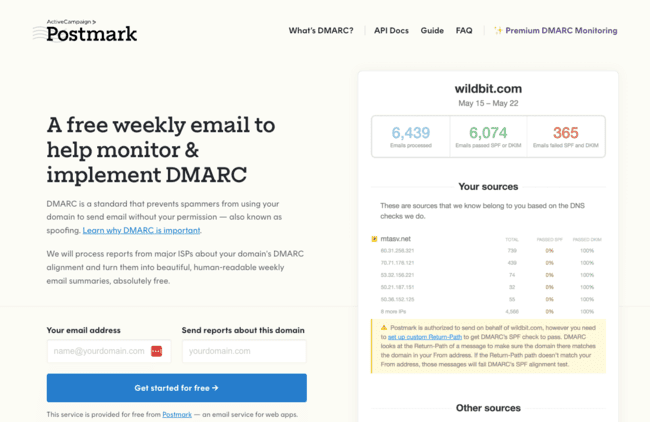
Postmark also runs a DMARC monitoring tool as an add-on. I’d rate this as one of the most user-friendly DMARC tools around. You provide a domain to monitor. And Postmark sends you weekly emails with easily digestible DMARC reports. Postmark runs checks against all sending sources and IP addresses associated with your domain. And then gives a simple breakdown of how many emails passed SPF and DKIM for each source.
Postmark’s DMARC monitoring tool is available for free and as a paid-for premium version. The free tool reports on the top 10 mail sources and top 5 IP addresses for each domain only. The paid version reports on all sources. The premium version also has a web dashboard for results.
Postmark Pros
- Standalone DMARC monitoring tool
- Simple and user-friendly
- Straightforward reports totalling weekly SPF and DKIM failures
Postmark Cons
- Real-time failure alerts or more regular reporting would be a bonus.
The Postmark DMARC monitor is free to use. But the free version monitors only select email sources and IPs. To get unlimited monitoring for all your domains, the paid version costs $14 a month.
Valimail
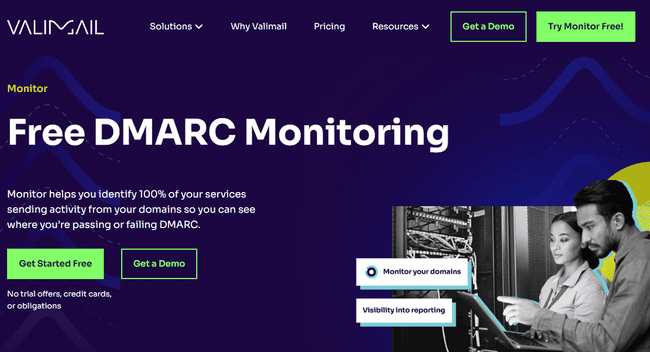
Valimail specializes in DMARC authentication. It has two standout USPs. One, it offers a DMARC monitoring service for free. And two, you can move from monitoring to stopping spoofing and phishing attacks. Making sure your whole sending set-up is compliant with popular mailbox providers.
Valimail’s DMARC monitoring tool tracks all sending services associated with your domain. It identifies all servers and IP addresses by name. So you get full visibility about the third-party sending services used in your chain. This lets you pinpoint where authentication failures are happening. It also identifies where unauthorized emails are being sent from. This is a big plus for larger organizations at high risk of spoofing attacks.
Those organizations can then use Valimail’s Enforce tool to stop the spoofing. This automates the whole authentication process. From configuring SPF and DKIM records to authorizing the sending services. Again, this is mainly aimed at bigger businesses with complex global sending requirements.
Another option to improve authentication and deliverability is the Align tool. This configures your sending services for Gmail, Outlook, and Yahoo! Authentication. Again, it’s all automated. And provides a simpler approach to improving authentication that might appeal to marketers.
Valimail Pros
- DMARC monitoring for free
- Full visibility of your sending infrastructure
- Identifies unauthorized sender sources
- Automates authentication set-up and mailbox alignment
Valimail Cons
- I’d prefer it if Valimail published pricing for its Enforce tool. Price on application is an extra hassle.
Valimail’s Align tool starts at $19 a month. This configures authentication for 500,000 emails. Valimail provides custom pricing on application for its Enforce tool. But costs start at around $2,000 a year.
PowerDMARC
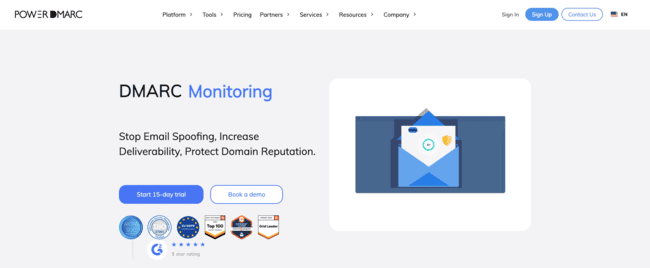
PowerDMARC combines DMARC analysis with hosted authentication services. Its analytics platform transforms raw DMARC reporting data into an impressive visual dashboard. This breaks DMARC performance down into eight different views. Including percentages of your emails that align with and pass DMARC, DKIM, and SPF. A full list of performance by sending services and IP addresses. A geographical breakdown of authentication failures. And AI analysis of the IP addresses posing the biggest spoofing risks. If you think your IP is causing deliverability issues, check out the best IP reputation checkers.
PowerDMARC’s hosted service provides a simple interface for authentication management. You can choose to configure and monitor DMARC, SPF, and DKIM separately. You can update records and change policies. PowerDMARC handles the technical side for you. So you are less likely to make mistakes that lead to deliverability issues.
Other features include IP, domain, and email blocklist tracking. And PowerDMARC has a range of free-to-use tools. Such as a DMARC generator and checker for a single email at a time.
PowerDMARC Pros
- Detailed visual dashboard for DMARC reports
- AI spoofing threat analysis
- Hosted authentication
PowerDMARC Cons
- PowerDMARC’s plan and pricing structure could be clearer.
PowerDMARC pricing starts at $8 a month. This lets you run analysis on 50,000 emails a month. There’s a cap of 2 million emails overall. Higher tiers are priced by application. You can analyze 10,000 emails for free.
DMARC Advisor
DMARC Advisor is a DMARC analyzer. It makes raw DMARC XML data accessible via a visual dashboard. It also provides real-time reporting for authentication incidents. And lets you manage DNS configuration in the same place as your monitoring.
DMARC Advisor’s dashboard is impressive for its combination of detail and accessibility. There’s an overview of every connected domain. Summarizing DMARC, DKIM, and SPF status by sender service and IP address. There’s a detailed breakdown of authentication by sending source used in the past 7 days. And you can dig down into the details of trends over time. Including looking at patterns in where and when threats are detected.
The reporting tool also identifies and flags up suspicious subdomains. And sends alerts for spoofs, non-compliant users, and authentication failures. This oversight feeds directly into authentication management. You can always see the live status of nodes in your sending infrastructure. And act to address configuration issues quickly.
DMARC Advisor Pros
- Detailed but accessible DMARC report dashboard
- Real-time alerts for spoofing threats, non-compliance, and authentication failures
- Manage DNS configuration from the same window
DMARC Advisor Cons
- The interface isn’t the slickest I’ve used and can be confusing.
DMARC Advisor pricing starts at $19 a month for 2 domains and 100,000 emails. There’s a free plan with 2 domains and 10,000 emails.
Dmarcian
Dmarcian was an early trend-setter in DMARC-based authentication protection. It was co-founded by one of the original authors of the DMARC protocol. It set the template for DMARC analysis that other firms have followed. Such as turning DMARC aggregate report data into a user-friendly visual dashboard.
Dmarcian’s dashboard provides breakdowns of DMARC, SPF, and DKIM status across connected domains. You can break down compliance and authentication issues by source. And track trends in threats and non-compliance by time and region.
Dmarcian also provides real-time alerts for all authentication failures. A really handy feature is that the Overview dashboard has tabs for tasks and issues. This gives you at-a-glance access to anything of concern. And actions to firm up your domain security.
Dmarcian also provides deployment services. This gives you professional support for implementing DMARC in your sending infrastructure. It also offers free tools such as individual and combined DMARC, SPF, and DKIM checkers. And a wizard for building a valid DMARC record.
Dmarcian Pros
- Detailed visual dashboards built from DMARC report data
- At-a-glance issues and actions summaries
- DMARC deployment service
Dmarcian Cons
- The visual design of Dmarcian’s dashboard could do with an update
- Companies from the Netherlands can’t sign up
Dmarcian pricing starts at $19.99 a month for 2 domains and 100,000 emails a month. There is a free plan for 2 domains and 1,250 emails a month.
Cloudflare Free DMARC Management Tool
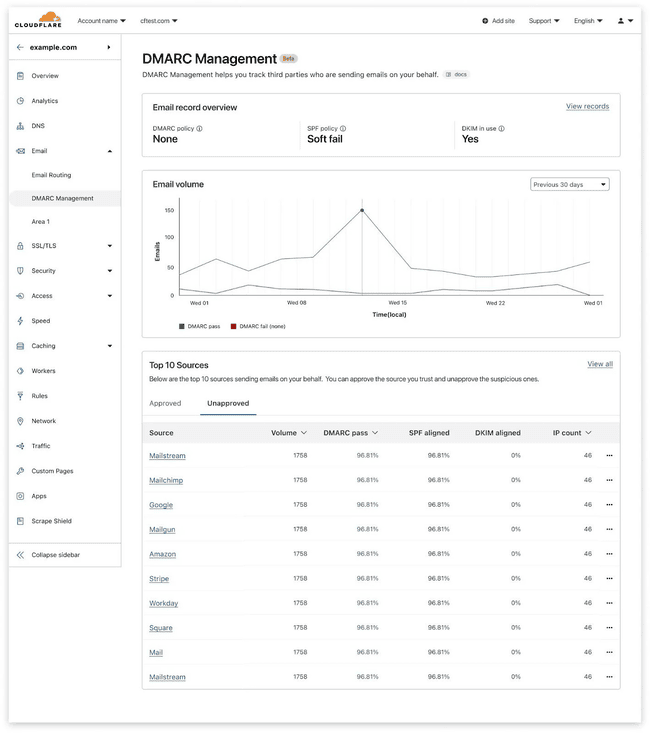
Cloudflare is one of the world’s biggest web services providers. It specializes in website performance and security. Its global content delivery networks (CDNs) speed up page load times and reliability. And multiple applications and zero-trust security products. Including enterprise-grade email security.
DMARC management extends Cloudflare’s zero-trust email security approach to all customers. It’s available as a bolt-on to Cloudflare’s standard DNS tools. And it comes at no extra cost, available to free plan users, too. It’s easily enabled via your account and domain settings.
The tool captures all DMARC reports from emails you send. It converts raw XML data into visual reports. Cloudflare’s DMARC analytics dashboard is accessible. But fairly basic both in design and in the data you see. You see DMARC passes and SPF and DKIM alignment figures for all emails sent from your domain. One strength is that it names each sending source.
Domain owners can approve any unapproved sources with a single click. Cloudflare takes care of authentication for you. And you can manage your DMARC policy in the platform.
Cloudflare DMARC Management Pros
- Free to all Cloudflare users
- Available on the free plan
- Automated DMARC analysis
- Names all sending sources for your domain
Cloudflare DMARC Management Cons
- You need a Cloudflare account to use it
Cloudflare plans start at $25 a month. There’s a free plan for personal websites.
Conclusion: DMARC Monitoring
A DMARC monitoring service is a smart move if you want to improve your email deliverability. Especially if your sender reputation seems to be taking a dive. And you suspect gaps in your email authentication are causing the issues. Either because you’re getting spoofed. Or you’re just not on top of your DKIM and SPF records.
I’d always go for an all-round deliverability service that includes DMARC monitoring. You get more for your money. Combined tools and protections will have a bigger impact on deliverability. That said, standalone DMARC tools can be useful. Especially if you’re a large-scale sender with a big, complex sending infrastructure.
So to round things off, my DMARC monitoring service recommendations are as follows:
- Best all-round deliverability platform: Bouncer
- Best for standalone DMARC monitoring: PowerDMARC
- Best for stopping spoofing: Valimail
- Best free DMARC tool: Postmark